Bringing Back the Night: How the Tiny Observatory and “Licht aus!” are Reconnecting People with the Universe
In an age defined by constant illumination, the night is quietly disappearing. What once inspired myths, navigation, science, and existential wonder is now often reduced to a faint glow behind a veil of artificial light. Across Europe—light pollution has become one of the most overlooked environmental challenges of our time. Yet, in Lower Saxony, a unique initiative is working to reverse that trend: the Tiny Observatory and the “Licht aus!” (lights out!) project by LEB in Niedersachsen e.V., developed in collaboration with the Carl von Ossietzky Universität Oldenburg. Together, they are bringing back the universe back to the people.
A Mobile Gateway to the Cosmos
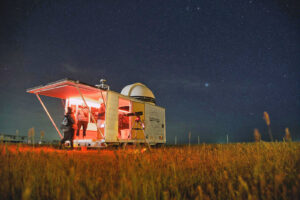
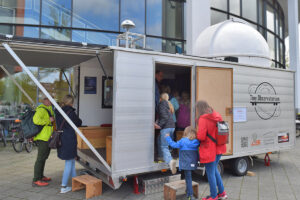
The Tiny Observatory is exactly what its name suggests—small in size, but immense in ambition. It is a fully mobile astronomical observatory housed in a custom-built trailer, designed to travel across the East Frisian Peninsula. Its mission is simple yet profound: to make the night sky accessible again.
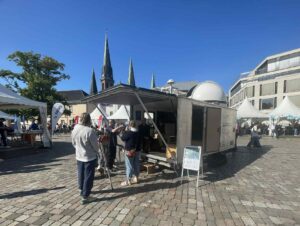
Rather than requiring people to travel to remote observatories or dark sky parks, the Tiny Observatory comes directly to communities—urban, rural, coastal, and inland. Equipped with two professional-grade telescopes, advanced imaging systems, and modern data processing tools, it transforms any location into a temporary window to the cosmos.
But this is not just about looking at stars. It’s about participation.
Visitors don’t simply observe—they engage. Guided by trained astronomy educators and “Dark Sky Guides,” they learn how to navigate the night sky, understand celestial phenomena, and even contribute to scientific observations. Through remote-controlled systems, participants can collect and analyze real astronomical data, which is shared publicly through digital platforms.
This fusion of education, science, and accessibility turns the Tiny Observatory into both a research instrument and a community gathering space.
The Hidden Crisis of Light Pollution
At the heart of the project lies a deeper purpose: raising awareness about light pollution.
Artificial light at night has become so normalized that its consequences are often invisible to the public. Yet its effects are far-reaching. Excessive light emissions disrupt ecosystems, alter animal behavior, and interfere with plant cycles. Nocturnal species are particularly vulnerable, as artificial lighting can disorient migration patterns, feeding habits, and reproduction.
Humans are not immune either. Scientific research increasingly links light pollution to sleep disorders, hormonal imbalances, and broader health concerns. Moreover, the cultural and philosophical loss is immense: entire generations are growing up without ever seeing a truly dark sky.
The “Licht aus!” (lights out!) initiative seeks to change that.
Funded by the Klaus Tschira Foundation, the project combines scientific measurement with public education. The Tiny Observatory plays a central role by collecting data on local light emissions while simultaneously hosting events that explain their impact. The goal is not to eliminate artificial light altogether, but to promote smarter, more sustainable lighting practices—reducing unnecessary illumination while preserving safety and functionality.
The goal is not to eliminate artificial light altogether, but to promote smarter, more sustainable lighting practices—reducing unnecessary illumination while preserving safety and functionality.
Education Meets Experience
What sets this initiative apart is its emphasis on experiential learning.
Rather than relying solely on lectures or written materials, the project immerses participants in the subject. Imagine standing by the Banter See in Wilhelmshaven, looking through a telescope at distant galaxies, while learning how nearby industrial lighting affects your ability to see them. The connection becomes immediate and personal.
This approach is further strengthened by the training of Dark Sky Guides—individuals who integrate knowledge about light pollution into guided tours and educational programs. These guides act as multipliers, carrying the message into their own communities and professional contexts.
The program also includes online lectures, workshops, and interactive sessions. Topics range from the biological effects of artificial light to the philosophical significance of darkness. One such lecture, “The Value of Darkness,” highlights how something as simple as reducing light can have profound ecological and cultural benefits. Importantly, all events are free of charge, ensuring accessibility for people of all backgrounds. This inclusivity reflects the project’s broader mission: to democratize access to science and foster curiosity across generations.
Importantly, all events are free of charge, ensuring accessibility for people of all backgrounds. This inclusivity reflects the project’s broader mission: to democratize access to science and foster curiosity across generations.
Reaching Diverse Audiences
The Tiny Observatory is designed for everyone.
Children experience their first glimpse of Saturn’s rings. Teenagers discover potential career paths in science and technology. Adults reconnect with a sense of wonder often lost in daily routines. Even those with no prior interest in astronomy find themselves captivated by the experience.
Special attention is given to rural areas, which are often underserved in science outreach initiatives. By bringing high-quality equipment and expertise directly to these regions, the project ensures that geographic location does not limit access to knowledge. At the same time, urban audiences are equally important. In cities, where light pollution is most severe, the contrast between expectation and reality becomes a powerful teaching tool. When people realize how much of the night sky is hidden from view, the urgency of the issue becomes clear.
At the same time, urban audiences are equally important. In cities, where light pollution is most severe, the contrast between expectation and reality becomes a powerful teaching tool. When people realize how much of the night sky is hidden from view, the urgency of the issue becomes clear.
A Journey Across Northern Germany
Since its launch in June 2023 as part of Germany’s “Science Year – Our Universe” (funded by the Bundesministerium für Bildung und Forschung) the Tiny Observatory has traveled extensively in Germany’s northwest. Locations have included Oldenburg, Wilhelmshaven, Carolinensiel, Bad Zwischenahn, Wardenburg, Cloppenburg, Spiekeroog and Großenkneten.
Each stop brings a tailored program, adapted to the local environment and audience. Coastal areas, for example, offer unique observational conditions and ecological contexts, while inland regions provide different challenges and opportunities related to lighting infrastructure. These journeys are more than logistical achievements—they represent a growing network of communities engaged in a shared mission. Partnerships with local organizations, educational institutions, and astronomy clubs further amplify the project’s reach.
These journeys are more than logistical achievements—they represent a growing network of communities engaged in a shared mission. Partnerships with local organizations, educational institutions, and astronomy clubs further amplify the project’s reach.
Technology with a Purpose
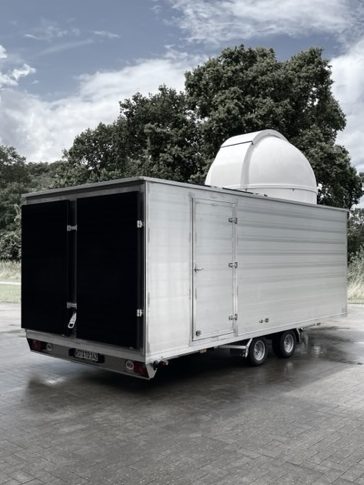
Built as a custom aluminum trailer with a dome structure, it houses a carefully designed interior featuring insulation, wooden fixtures, and a sophisticated lifting system for the telescopes, developed within an LEB project. The technical components—installed by the University of Oldenburg—include high-resolution cameras, computer systems, projection capabilities, and even a photovoltaic system for energy supply. This self-sufficiency is symbolic. It reflects the project’s commitment to sustainability and innovation, demonstrating how technology can be used responsibly to explore and protect the natural world.
This self-sufficiency is symbolic. It reflects the project’s commitment to sustainability and innovation, demonstrating how technology can be used responsibly to explore and protect the natural world.
From Observation to Participation
One of the most exciting aspects of the Tiny Observatory is its emphasis on citizen science.
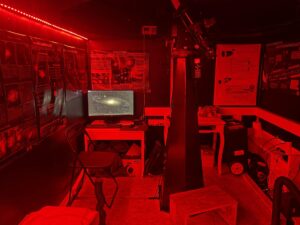
Participants are not just passive observers; they can actively contribute to ongoing research. Through remote access, they can control telescopes, capture images, and analyze data. These contributions are documented and shared via an online dashboard, making scientific processes transparent and collaborative. This approach bridges the gap between professional scientists and the public. It demystifies research and shows that science is not an exclusive domain, but a collective endeavor.
This approach bridges the gap between professional scientists and the public. It demystifies research and shows that science is not an exclusive domain, but a collective endeavor.
What Has Been Achieved So Far?
Since its inception, the project has achieved several key milestones:
- High public engagement: Events consistently attract strong interest, indicating a widespread curiosity about astronomy and environmental issues.
- Increased awareness: Many participants report a newfound understanding of light pollution and its consequences.
- Educational impact: Schools, families, and individuals benefit from hands-on learning experiences that go beyond traditional formats.
- Community building: The initiative fosters connections between institutions, local organizations, and citizens.
- Scientific contribution: Data collected through the observatory supports ongoing research and monitoring efforts.
Perhaps most importantly, the project has sparked conversations—about how we use light, how we design our environments, and how we relate to the natural world.
Looking Ahead
The journey is far from over.
Future plans include expanding the network of Dark Sky Guides, increasing the number of observation sites, and enhancing digital participation tools. Training programs are already scheduled, ensuring that more people can become ambassadors for dark skies. There is also potential for broader impact. As awareness grows, municipalities and policymakers may begin to adopt more sustainable lighting strategies. The data and experiences generated by the project can serve as valuable resources in these discussions.
Why Darkness Matters
At its core, the Tiny Observatory and “Lights Out!” project are about more than astronomy or environmental protection. They are about perspective.
Looking at the night sky has always been a deeply human experience. It invites questions about our place in the universe, the nature of existence, and the boundaries of knowledge. When that experience is lost, something fundamental is lost with it.
Conclusion
By bringing the universe back into view, this initiative restores not just visibility, but meaning.
It reminds us that darkness is not something to be feared or eliminated, but something to be valued and protected. In a world that is constantly switched on, perhaps the most radical act is simply to turn off the lights—and look up.
The Tiny Observatory stands as a powerful example of what can happen when science, education, and community engagement come together with a clear purpose. Through its innovative approach, it addresses one of the most overlooked environmental issues of our time while inspiring people to reconnect with the cosmos.
In doing so, it achieves something rare: it makes the invisible visible again—not just the stars above, but the impact of our actions here on Earth.
And sometimes, all it takes to change perspective… is a little less light.
Authors: Team Project “Licht aus” of the LEB in Lower Saxony e.V. und University Oldenburg.
Photos: LEB
Disclaimer: Tiny Observatory is not a project of the ELPC, we simply want to inform about such projects.
For more information visit:
https://weser-ems.leb-niedersachsen.de/tiny-obs.html